
How do you identify this pest?
What does it look like?
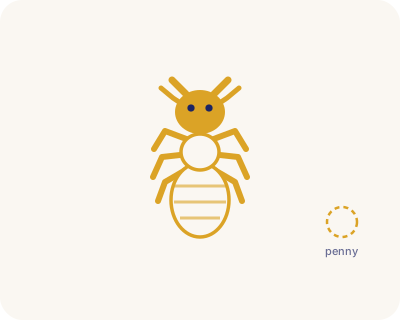
Workers are about 1/8 to 1/4 inch long. Swarmers are about 3/8 to 1/2 inch long
Workers are creamy white. Swarmers are dark brown or black
Which features set it apart?
- Straight antennae with bead-like segments
- A broad waist, so the body looks like one tube
- Swarmers have two pairs of see-through wings of equal length, nearly twice as long as the body
What is this pest often mistaken for?
- flying ants
- Ants have elbowed antennae with a sharp bend. Termites have straight antennae
- Ants have a pinched waist. Termites have a broad waist
- An ant's front wings are larger than its back wings. A termite's four wings are all the same length and shape
What are the signs of an infestation?
- Mud tubes: Earth-colored tubes that give termites a protected runway from the soil to the wood they eat. Look on cellar walls, wooden posts, wall studs, sill plates, and door and window trim. Penn State Extension
- Discarded wings: Swarmers that get indoors usually die, so often you find only dead swarmers or just their wings. Look on windowsills, near lights and by doors. NC State Extension
- Damaged wood: Feeding follows the grain of the wood, eating the softer layers and leaving the harder ones, with soil in the tunnels. Darkened or blistered structural wood is another sign. UC IPM Pest Notes: Termites
- Live insects: If you break a tube open, you may see live workers and soldiers moving inside, which confirms the tube is active. UC IPM Pest Notes: Termites
What damage does it do to a home?
- Termites hollow out structural wood from the inside along the grain, so damaged wood can look sound on the surface. UC IPM Pest Notes: Termites
When is this pest active?
Pest activity follows the weather, so timing matters. Treating inside the active window is usually cheaper and more effective than waiting for the problem to grow.
| Jan | Feb | Mar | Apr | May | Jun | Jul | Aug | Sep | Oct | Nov | Dec |
|---|---|---|---|---|---|---|---|---|---|---|---|
| Low | Rising | Peak | Peak | Peak | Rising | Low | Low | Low | Low | Low | Low |
What triggers a change in activity?
When does acting early pay off?
How does the timing shift by region?
-6
0
1
3
What do bites and stings from this pest look like?
What can a bite tell you, and what can it not?
Bites from different insects often look alike. The same insect can cause very different reactions in different people, and many people never react at all. A bite cannot identify a species.
This is general information, not medical advice. If you are worried about a bite or a reaction, see a doctor.
What should you do right now?
These are steps a homeowner can take today, before anyone visits. None of them replace a licensed local company once an infestation is established.
- Collect a few of the insects or wings in a sealed bag so a pro or extension specialist can identify them. NC State Extension
- Remove any contact between wood and soil, such as wooden steps or support posts. Clemson HGIC
- Fix leaks and moisture problems. Termites prefer moist or decayed wood. Clemson HGIC
- Keep about 6 inches of foundation visible so tubes can be seen. NC State Extension
- Get a professional inspection. Treatment needs licensed operators and special equipment. Penn State Extension
Want a local company to handle Termites?
PestChief is free to the homeowner. Your request goes to one independent local pest control company that covers your ZIP code and handles that pest, not to seven. That company contacts you directly to confirm details and arrange a visit.
What does treatment typically cost?
What you pay depends on the pest, the size of the property and how far the problem has spread.
These are national estimates drawn from published industry sources, not PestChief quotes. Every figure states the basis it is measured on. The real price comes from the company that inspects your home.
When should you call a pest control company?
Call when the job has outgrown a homeowner fix. The usual signs are damage to wood, wiring or insulation, activity that returns within weeks of treating it, a nest or colony you cannot reach safely, and any pest that bites or stings people living in the home. Specialty pests need specific state licensing to treat, so the work has to go to a licensed company.
PestChief does not spray, trap or treat pests. Give your ZIP code and the pest you are seeing, and PestChief passes the request to one independent local pest control company that covers your address and handles that pest. That company contacts you directly to confirm details and arrange a visit. The service is free to the homeowner, and the company sets its own price.
How do I know if I have termites?
Termites work out of sight, so most homeowners find one of four signs rather than the insects themselves: mud tubes on foundation walls or piers, discarded wings near windows after a swarm, hollow or blistered wood that gives under a screwdriver, and small piles of hard pellets, which point to drywood termites rather than subterranean ones.
A swarm of winged insects indoors in spring is the most common trigger for a call. Termite swarmers have a straight waist, straight antennae and four wings of equal length, while ant swarmers have a pinched waist, bent antennae and unequal wings.
| Type | Where it lives | Signs | Typical treatment |
|---|---|---|---|
| Eastern subterranean | Soil contact with the structure, most of the country | Mud tubes, damaged wood with soil inside | Liquid soil barrier or in-ground bait system |
| Formosan subterranean | Gulf Coast states, notably Louisiana and coastal Texas and Florida | Large aggressive colonies, carton nests in walls | Aggressive liquid treatment plus baiting, faster response needed |
| Drywood | Dry sound wood, the South, southern California, Hawaii | Hard six-sided pellets, kick-out holes | Localized treatment or whole-structure fumigation |
| Dampwood | Water-damaged wood, Pacific Northwest and coastal areas | Damage tied to a leak or ground contact | Correct the moisture source, then treat |
Why do termites require a licensed specialist?
Termite work is regulated differently from general pest control in most states, which typically require a separate license category and a written treatment proposal and inspection report, often on a state-prescribed form. The reason is that a termite treatment is a structural protection measure, and an incomplete barrier is worse than no barrier because it gives false confidence.
The EPA describes both liquid soil treatments and bait systems as legitimate approaches, and says the choice depends on the structure and the situation. That decision needs someone who has crawled under your house, not a phone quote.
Liquid barrier or bait system?
| Liquid soil barrier | In-ground bait system | |
|---|---|---|
| How it works | A treated zone in the soil around and under the structure | Stations around the property deliver a growth inhibitor to foraging termites |
| Speed | Protects immediately once complete | Takes weeks to months to eliminate the colony |
| Disruption | Trenching, sometimes drilling slabs and patios | Minimal digging, small stations in the soil |
| Ongoing cost | Renewal or re-treatment at intervals | Annual monitoring and service fee |
| Best suited to | Active infestation needing immediate protection | Long-term protection, complex structures, chemical-sensitive sites |
What does a termite treatment involve?
- A full inspection of the foundation, crawlspace, slab edges, plumbing penetrations and accessible wood
- A written report identifying species, evidence found and areas of damage
- Trenching and treating the soil, and drilling where a slab, porch or patio abuts the structure
- Or installation of in-ground bait stations at intervals around the structure
- Correction of moisture and wood-to-soil contact that invited the colony
- A follow-up inspection schedule, usually annual, and often a warranty or bond
When do termites swarm?
Subterranean termites typically swarm on warm days in spring, often after rain, and that is when most homeowners discover them. Formosan termites swarm in late spring and early summer in the Gulf South, usually at dusk, and are strongly attracted to lights. Drywood termites swarm later in the summer and into fall in the South and West.
Swarming indoors means an established colony in or under the structure. Swarming outdoors near the house means colony pressure nearby and is a good reason to get an inspection before it becomes an interior problem.
Why can a termite match take longer?
Termite treatment requires specific licensing and equipment, so fewer companies offer it than offer general pest control, and coverage is thinner in rural counties. PestChief matches on ZIP code coverage and the pest handled, never on price, so a termite request goes to a company that does termite work. That can take longer than a request for ants or spiders.
Frequently asked questions
How much does termite treatment cost?
A full subterranean termite treatment on an average home commonly runs $1,200 to $3,500, with bait systems adding an annual monitoring fee. Spot drywood treatment is usually less, and whole-structure fumigation is typically more. These are national estimates from published sources, not a PestChief quote, and the company that inspects your home sets its own price.
How fast do termites damage a house?
Termite damage develops over months and years rather than days, so there is time to get a proper inspection and a considered treatment plan. Formosan colonies in the Gulf South work faster than eastern subterranean colonies and warrant quicker action.
Does a termite swarm mean I already have damage?
A termite swarm indoors means a mature colony is established in or under the structure, so some damage is likely, though it may be limited. A swarm outdoors indicates colony activity nearby and justifies an inspection.
Is a liquid barrier or a bait system better for termites?
Neither termite approach is universally better. Liquid soil barriers protect immediately and suit active infestations. Bait systems avoid trenching and drilling and eliminate the colony over weeks to months, which suits complex structures and long-term protection.
Does homeowners insurance cover termite damage?
Standard US homeowners policies generally exclude termite damage on the basis that it is preventable and gradual. Check your own policy, and ask about a treatment warranty or bond when you get a quote.
How often should a home be inspected for termites?
An annual termite inspection is the common professional recommendation, and it is usually required to keep a termite warranty or bond in force. Homes in high-pressure areas such as the Gulf Coast benefit most from keeping to that schedule.
Can I treat termites myself?
Realistically, no. A complete soil barrier requires trenching and often drilling slabs at precise volumes, and most states regulate termite work under a separate license. Incomplete treatment leaves gaps the colony finds.
Do I have termites or carpenter ants?
Termites leave mud tubes and soil-packed galleries and produce straight-waisted swarmers with wings of equal length. Carpenter ants leave coarse sawdust with insect parts and produce pinch-waisted swarmers with unequal wings.
Does PestChief treat termites?
No. PestChief does not inspect, treat or fumigate anything. PestChief takes your ZIP code and the pest you are seeing and passes the request to one independent local pest control company that covers your address and handles termite work. That company contacts you directly. The service is free to homeowners.
Who wrote this page?
Written by the PestChief editorial team. PestChief does not spray, trap or treat pests, so nothing on this page is a treatment recommendation from a business that would be paid to carry it out.
October 6, 2026
Factual claims on this page are cited under Sources below, to published government agencies, university extension services and industry bodies.